Sounding 010 — Jõudu tarvis (Strength is needed)
Jõudu tarvis (Strength is needed)
Nahtrunar’s Wolfsstunde is an Austrian black-metal record made from six pieces and forty-six minutes, but it behaves like a single passage undertaken during one hour: that seam between night and morning in which sleep is deepest, nightmares acquire the weight of facts, and the sleepless are left alone with whatever has been waiting for them.
The title recalls Ingmar Bergman’s account of the wolf’s hour: the time when most people die, most children are born, and demons possess their greatest power. Whether or not Nahtrunar means the phrase through Bergman, the record inhabits the same suspended territory. It begins as if something buried has been disturbed and ends not with daylight exactly, but with Alte Heiligkeit—Old Holiness—a light without a settled shape.
This is more than an atmosphere placed around a collection of songs. The album has been ordered as a journey: Fund, Odal I, Wolfsstunde, Neun Weihenächte, Odal II, and Alte Heiligkeit. Four long compositions are divided by two brief interludes bearing the same name, as though the listener crosses one threshold twice. The interludes are not rests between the important things. They alter the air around them. They make the record feel less like a succession of tracks than a nocturnal rite whose meaning cannot be reached directly.
The opening piece, Fund, means a find: something discovered, but also the object that has been found. It contains much of the record in embryo. Its black metal is cold and physically forceful, yet acoustic guitar and cello open chambers inside it rather than offering relief from it. Those quieter materials do not belong to another, gentler composition. They seem to have been excavated from within the distorted one. The music repeatedly creates this sensation: beneath the amplified surface lies an older melody, and beneath that melody lies something older still, inaccessible except as feeling.
That is what first took hold of me. A song sets out with one bare, mourning figure and then rises, without a seam, into the full violence of the band—the drums breaking open, the guitars multiplying into weather, the voice arriving already torn. Yet it never sounds like a folk introduction attached to a metal song. The two forms retain the same melodic gravity. The metal is the folk song carried beyond the point at which an ordinary human voice could contain it.
This distinguishes Wolfsstunde from music in which “folk” operates as ornament: an acoustic prelude, an old instrument, a pastoral interval inserted to authenticate the heavier material. Nahtrunar’s folk passages do not decorate the black metal or certify its ancestry. They expose its skeleton. When the distortion enters, it enlarges what was already present in the quiet melody: grief, endurance, terror, and a beauty severe enough to wound.
The cover prepares this movement. It abandons the black-and-white photographic imagery of Nahtrunar’s previous records for a painted, snowbound settlement beneath a vast, dim sky. The human structures are small, nearly swallowed by the weather. The image possesses something of the emotional scale of Romantic landscape painting, but without the triumphant solitary figure who stands above nature and converts it into revelation. Here there is no mastery. The settlement survives inside the landscape on sufferance.
Even the record’s production seems answerable to that image. Its coldness is not merely the familiar frost applied to black metal: it establishes distance. The guitars are less like individual instruments than masses moving across a horizon, while the vocals sound stranded within them. Melodies appear, are obscured, and return in altered forms, the way a known path becomes strange beneath snow. The record’s force lies not only in its climaxes, but in the feeling that every climax has travelled a considerable distance to reach us.
At its centre, the title track gives the album’s hour its body. It begins with deliberation rather than immediate assault. Dread is allowed to accumulate until the anguished voice no longer seems to be performing fear but reporting from inside it. Neun Weihenächte—Nine Nights of Consecration—then pushes the nocturnal passage towards ritual and transformation. The titles give us discovery, inheritance, the wolf’s hour, consecrated nights and old holiness, but they do not arrange themselves into a decipherable doctrine. Nahtrunar describes the German lyrics as symbolist poems built from wordplay and contradictory associations. The record does not explain its sacred world. It lets that world remain partly illegible.
My weakness is the final piece, Alte Heiligkeit, and especially its opening minutes. After Odal II, the small folk melody feels almost impossibly exposed. It is grave but not hopeless, intimate but without comfort. I do not hear it as a reconstruction of any identifiable historical music. It feels instead like something remembered without ever having been learned: not a recovered artefact, but the ache of recognition itself.
When the metal finally rises from that opening, it does not destroy the melody. It reveals the magnitude concealed inside it. The heart-wrenching voice belongs to the same song because it is crying out from the same ground. The gentleness and the violence are not opposites. One contains the other. The scream is what the melody becomes when its sorrow can no longer remain at human volume.
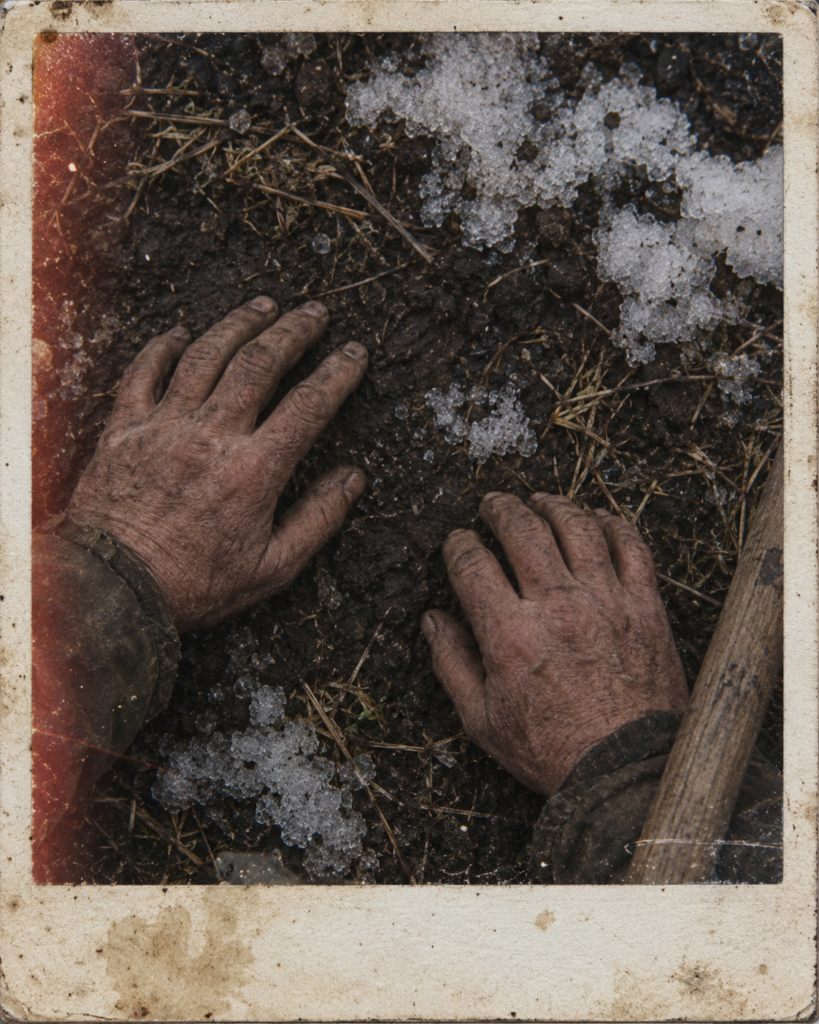
What this wakes in me is a kind of belonging, although not belonging to a country or to a people set apart from another. There is an Estonian greeting I grew up around, offered to somebody encountered at their labour: jõudu—strength. The answer is jõudu tarvis: strength is needed. The exchange asks no questions. It sees a body occupied by the hard work of living and sends strength towards it.
That is the human figure I find inside Wolfsstunde: not the warrior so beloved by metal mythology, nor an idealised ancestor standing guard over inherited territory, but someone working within a beautiful and difficult world. The landscape offers no proof of greatness and grants no ownership. It is simply there—immense, material and indifferent—and the person inside it continues. Jõudu. Strength to you. Tarvis. It is needed.
I am an agnostic — I keep no old gods and follow no occult discipline. What reaches me in this record is something barer: its intimacy with the earth, with mortality, and with the innumerable people who have worked upon the earth without ever owning it.
The record’s two interludes are titled Odal, a word and rune associated archaically with inheritance or ancestral property, but later appropriated by Nazism and still used by the far right. Nahtrunar addresses this in the album notes. The artist insists that the runes appearing around Wolfsstunde are used only in their archaic and enigmatic senses and that contemporary interpretations “could not be further away” from the work.
I am writing in Berlin before the elections of 20 September 2026, when the city will elect its House of Representatives and twelve district assemblies. The far right is not an obscure contamination at the edge of an underground scene; it is an expanding electoral force. This is why initiatives such as A Blaze Ansuz: Antifascist Neofolk matter. It treats neofolk as contested cultural ground and refuses to surrender folk music, pagan imagery, Romanticism, ritual or attachment to the earth to fascism. These forms can carry resistance, ecological awareness and anti-racism. They can imagine belonging without borders, bloodlines or inherited claims to land. Fascists have no legitimate ownership of this culture, but their claim will not disappear unless musicians, labels, writers and listeners oppose it openly.
Wolfsstunde begins with a finding and ends with an old holiness that cannot be clearly named. Between them, it crosses fear, dream, ritual, winter and inheritance. Its gentlest melodies carry its greatest weight; its violence seems to grow from their roots. By the end, the wolf’s hour has not been defeated, but passed through. Something comes into view—not a flag, an ancestor or a promised homeland, but the ordinary miracle of continuing until morning.
That is where jõudu returns to me. Strength offered to whoever is doing the hard work of being alive. It does not ask for a name, a bloodline or a place of birth. The old melody can be carried through the wolf’s hour without being surrendered to those who would sharpen it into hatred. If Alte Heiligkeit leaves me with a sense of home, it is not the home of nation or inheritance. It is a temporary shelter made within the music—open, unguarded, and the size of the earth.